Villages5 min read
Visiting Obernai: what to do in the great northern stop of the Wine Route?
Updated on
In brief
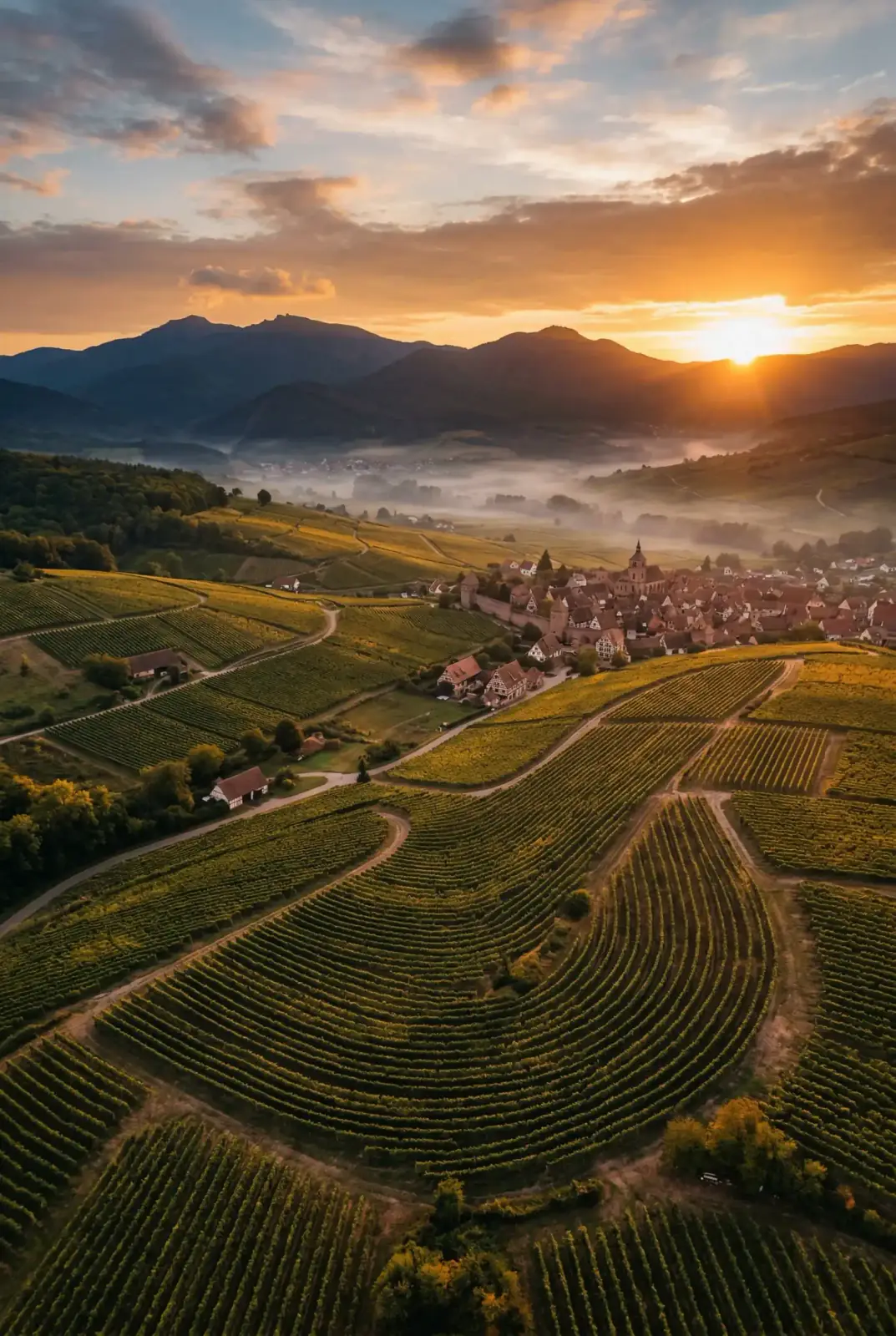
Obernai, 30 km southwest of Strasbourg, is the great northern stop of the Wine Route: a Market Square with colourful facades, the Kapellturm belfry, complete ramparts and the Schenkenberg vineyard on the heights. Birthplace of Saint Odile, patron saint of Alsace, it is visited in 2 hours, a full day with Mont Sainte-Odile added. A rare privilege: Obernai has a train station, 35 minutes from Strasbourg by regional train.
Visiting Obernai means discovering the town-sized version of the Wine Route: fuller than the vineyard villages, this Bas-Rhin city lines up a monumental market square, a Gothic belfry and near-intact ramparts, with the Schenkenberg vines as a backdrop and Mont Sainte-Odile on the balcony above. An ideal stop from Strasbourg, reachable by train, it opens the northern part of the vineyard. Follow the guide: the centre's essentials, the Schenkenberg vineyard, the seasons to favour and access by train or car.
Why Obernai deserves a stop
Obernai ranks among the most visited towns in Alsace, and its prosperity shows in the stone: a member of the Decapole, the league of ten free towns of Alsace, it kept from its golden age one of the finest market squares in the region. It is also the birthplace of Saint Odile, patron saint of Alsace, whose abbey founded on the mount bearing her name watches over the town. Its size makes it a complete stop: heritage, vineyard, shops and renowned tables within one perimeter.
What to do in Obernai: the essentials
The centre is explored on foot in two hours. The key stops:
- The Market Square: the 1554 corn exchange, the town hall and colourful facades form one of the finest urban ensembles in Alsace.
- The Kapellturm: a Gothic belfry of some sixty metres, the tower of a vanished chapel and the town's symbol.
- The Six Buckets Well: a Renaissance well from 1579, a masterpiece of ironwork and carved sandstone.
- The ramparts: the medieval wall can be walked almost in full along the shaded promenade.
- The Schenkenberg vineyard trail: a ninety-minute loop through the vines above the town, with educational panels and views over the plain.
- 20 minutes away: Mont Sainte-Odile, its abbey and its pagan wall, the spiritual belvedere of Alsace.
Where to taste: the Schenkenberg and the town's estates
Obernai's vineyard spreads over the Schenkenberg hill, which grows the full range of Alsace varieties with a fine reputation for Rieslings and Pinots. The town's family estates, such as Robert Blanck and Domaine Seilly, open their tasting rooms in or right next to the centre, and the Clos Sainte-Odile keeps the local wine memory alive. Obernai's position also lets you radiate towards the neighbouring grands crus: the Kirchberg de Barr and the Zotzenberg of Mittelbergheim, the only Alsace grand cru admitting Sylvaner, are less than ten minutes away. Expect around 35 euros for a guided cellar visit with tasting.
How to get to Obernai
This is Obernai's trump card: the town has a train station, served by regional trains from Strasbourg in about 35 minutes, a rarity on the Wine Route. By car, allow 30 minutes from Strasbourg via the A35 then the D426, and 45 minutes from Colmar. Park at the rampart car parks; parking remains easier than in the Haut-Rhin villages, except in December. From Strasbourg-Entzheim airport, Obernai is only 20 minutes away: it is often the first stop for arriving visitors.
When to visit Obernai
Obernai lives well all year round thanks to its size, with two highlights. In mid-October, the Harvest Festival, one of the largest in Alsace, celebrates the grapes brought in with a float procession, brotherhoods and open cellars. In December, the Christmas market takes over the Market Square around the tree and gourmet traditions, in a more local atmosphere than the big machines of Strasbourg or Colmar. In summer, the square's terraces and the vineyard trail at sunset are the two evening pleasures.
Visiting Obernai with FJ13 private driver
Obernai is the natural gateway to the Wine Route from Strasbourg, and it gives its best when radiating outwards: Barr, Mittelbergheim, Mont Sainte-Odile and Dambach-la-Ville line up to the south. The FJ13 private driver lets you chain these stops without parking or drink-driving constraints, departing from Strasbourg, from Obernai itself or from Entzheim airport:
- Sedan for 1 to 3 passengers, van for 4 to 7 passengers.
- Tailor-made tour combining Obernai, Mont Sainte-Odile, Barr and Mittelbergheim.
- Pick-up at your hotel, at Obernai station or at the airport.
- Online booking via the configurator, with an instant quote.
Frequently asked questions
Why is Obernai famous?
For its Market Square, one of the finest in Alsace, its Kapellturm belfry, its almost complete ramparts and its status as the birthplace of Saint Odile, patron saint of Alsace. It is one of the most visited towns in the region.
How long does it take to visit Obernai?
Allow 2 hours for the historic centre and the ramparts, half a day with the Schenkenberg vineyard trail or a tasting, and a full day if you add Mont Sainte-Odile.
Can you get to Obernai by train?
Yes, it is one of the rare Wine Route stops reachable by regional train: about 35 minutes from Strasbourg, with regular daytime services. The station is a ten-minute walk from the Market Square.
Which wines should you taste in Obernai?
The wines of the Schenkenberg, the town's vineyard hill, at family estates such as Robert Blanck or Seilly. Less than ten minutes away, the Kirchberg de Barr and the Zotzenberg of Mittelbergheim add two grands crus to the programme.
What is there to see at Mont Sainte-Odile?
The abbey founded by Saint Odile, a major pilgrimage site of Alsace, its panorama over the plain and the pagan wall, a mysterious megalithic enclosure over ten kilometres long. Allow half a day from Obernai, a 20-minute drive.
When is the Obernai Harvest Festival?
In mid-October, over a weekend. A procession of decorated floats, wine brotherhoods, open cellars and street events make it one of the largest harvest festivals in Alsace. Exact dates change every year.
Ready to plan your day?
Build your custom itinerary or browse our ready-to-book tours.