Villages5 min read
Visiting Riquewihr: what to do in the pearl of the Alsace vineyard?
Updated on
In brief
Riquewihr, listed among the Most Beautiful Villages of France, came through the wars unscathed: its main street lines up houses from the 15th to 18th centuries below the Dolder, a belfry from 1291. 13 km from Colmar, the town is visited in 2 hours, half a day with a tasting on the Schoenenbourg and Sporen grands crus, at Hugel or Dopff. Pedestrian centre: park outside or come with a private driver.
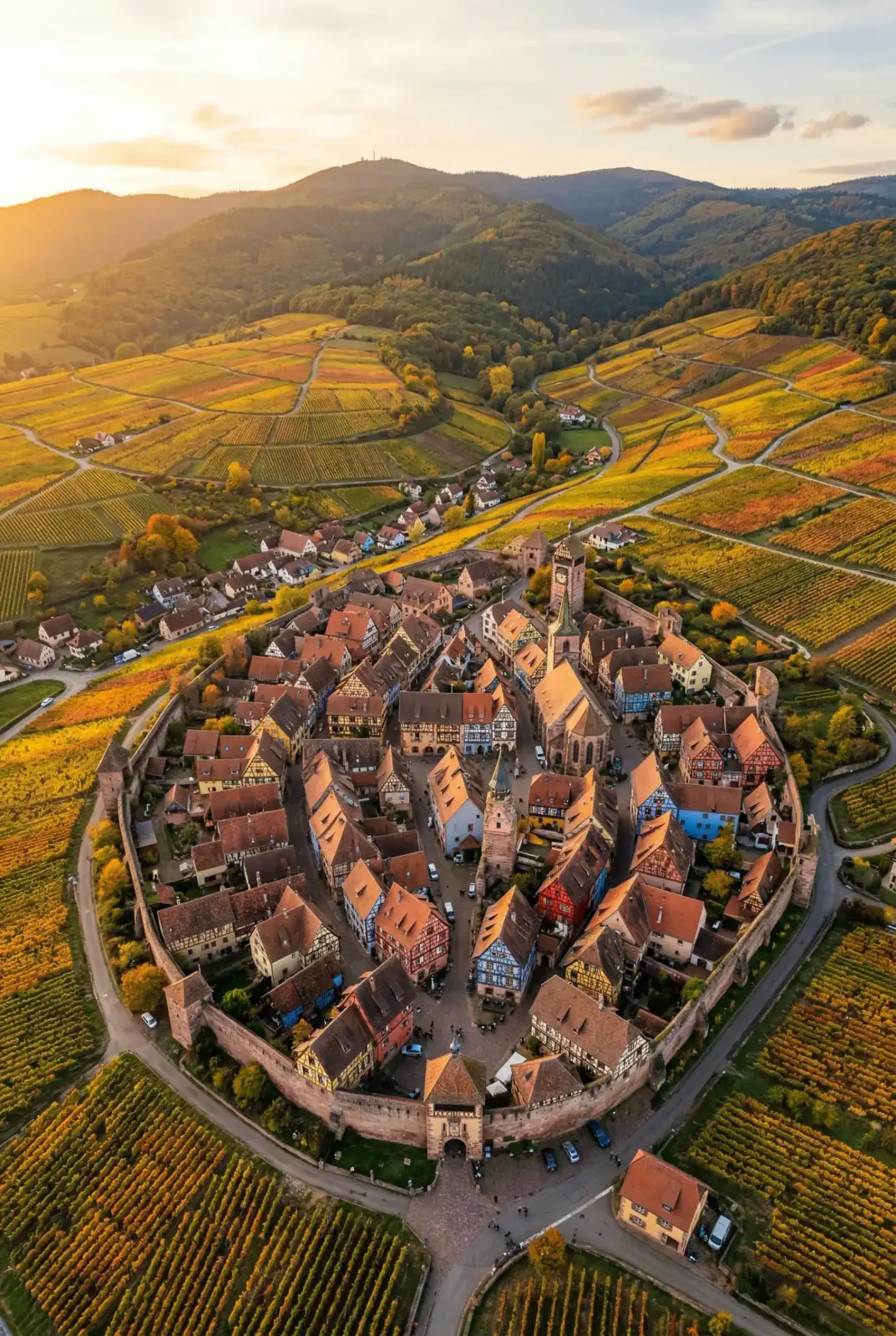
Visiting Riquewihr means walking up a street where four centuries of Alsatian architecture stand shoulder to shoulder, miraculously spared by the conflicts. The fortified town, nicknamed the pearl of the vineyard, stacks up superlatives: a listed village, complete ramparts, and two historic grands crus on its slopes. The price of success is the crowd that presses in during the season. This guide gathers what to see, where to taste, when to come and how to outsmart the rush.
Why Riquewihr deserves a stop
Riquewihr is one of the rare villages in Alsace to have come through the Second World War without destruction: its historic centre is a life-size conservatory of Rhenish architecture, from Gothic houses to Renaissance facades. Listed among the Most Beautiful Villages of France, the town belonged to the dukes of Wurtemberg, whose castle now houses the Museum of Communication in Alsace. Its silhouette amid the vines, unchanged for centuries, is the picture-postcard image of the Wine Route.
What to do in Riquewihr: the essentials
The centre is covered on foot in two hours. The key stops:
- Rue du General-de-Gaulle: the main artery climbs between wrought-iron signs and half-timbered houses from the 15th to 18th centuries.
- The Dolder: a 25-metre belfry from 1291, symbol of the town, with a small museum on the fortifications; rooftop views from the parapet walk.
- The Thieves' Tower: a former prison with its torture chamber, a raw testimony of medieval justice.
- The ramparts: the double wall can still be followed along much of the perimeter, on the vineyard side.
- The winegrowers' courtyards: push open the carriage doors, the village's finest inner courtyards hide behind them.
Where to taste: Schoenenbourg, Sporen and the historic houses
Two grands crus frame the town: the Schoenenbourg to the north, a Riesling terroir long renowned for its age-worthy wines, and the Sporen to the south, home of opulent Gewurztraminers. Riquewihr hosts some of the oldest wine houses in Alsace: Hugel et Fils, founded in 1639, whose sign adorns the main street, Dopff au Moulin, a pioneer of Crémant d'Alsace, and Dopff et Irion. Most tasting rooms open during the day without appointment; expect around 35 euros for a guided cellar visit, and buy the Schoenenbourg young to cellar it.
How to get to Riquewihr
Riquewihr lies 13 km northwest of Colmar, about twenty minutes via the D4 through Ostheim, and an hour from Strasbourg via the A35. The village has no train station; buses from Colmar are rare. The historic centre is fully pedestrian: cars park at the paying car parks by the town gates. In high season and during the Christmas market, they fill up by late morning and access traffic backs up for several kilometres.
When to visit Riquewihr
From April to October, the town lives to the vineyard's rhythm, with peak crowds on summer weekends and a moment of grace during the September harvest, when the slopes come alive. The Christmas market turns the main street into a fairy-tale set from late November to late December: magical, but very busy at weekends. The golden rule applies here more than anywhere: come on weekdays, before 10 am or after 5 pm, when the coaches leave and the village returns to its inhabitants.
Visiting Riquewihr with FJ13 private driver
Crowds are Riquewihr's main difficulty: saturated car parks, congested access, and no tasting for whoever takes the wheel again. The FJ13 private driver turns the constraint into comfort: drop-off at the town gates at off-peak times, pick-up on demand, and full freedom in the historic cellars. The service operates from Strasbourg, Colmar or Strasbourg-Entzheim airport:
- Sedan for 1 to 3 passengers, van for 4 to 7 passengers.
- Tailor-made tour combining Riquewihr, Hunawihr, Ribeauvillé and Kaysersberg in one day.
- Schedules designed to avoid the village's peak hours.
- Online booking via the configurator, with an instant quote.
Frequently asked questions
Why is Riquewihr nicknamed the pearl of the vineyard?
Because the fortified town, spared by the wars, preserves intact an exceptional ensemble of houses from the 15th to 18th centuries amid the vines. It is listed among the Most Beautiful Villages of France.
How long does it take to visit Riquewihr?
Allow 2 hours for the main street, the Dolder and the ramparts, and half a day if you add a tasting at a winegrower's and the Museum of Communication.
How do you get to Riquewihr without a car?
The village has no train station and buses from Colmar are rare. The simplest solution is a private driver: FJ13 picks you up in Strasbourg, Colmar or at Entzheim airport and drops you at the gates of the pedestrian town.
Where do you park in Riquewihr?
At the paying car parks by the village entrances, as the centre is pedestrian. In season and during the Christmas market they fill up by late morning: arrive early or get dropped off.
Which wines should you taste in Riquewihr?
The Riesling of the Schoenenbourg grand cru, a renowned ageing wine, and the Gewurztraminer of the Sporen. The historic houses Hugel et Fils, Dopff au Moulin and Dopff et Irion have their tasting rooms in the village.
Is the Riquewihr Christmas market worth it?
Yes, the medieval setting makes it one of the most photogenic in Alsace, from late November to late December. Prefer weekdays: on Saturdays and Sundays the crowds make the main street hard to walk.
Ready to plan your day?
Build your custom itinerary or browse our ready-to-book tours.